
Here’s something most leadership teams miss: when employees don’t receive adequate training, they don’t just fall behind on skills. They conclude their company doesn’t care about their growth. That perception cascades into measurable performance damage that blocks the very business results leaders are trying to achieve.
Download The Real Cost of Inadequate Training and Development Infographic
The Perception Problem
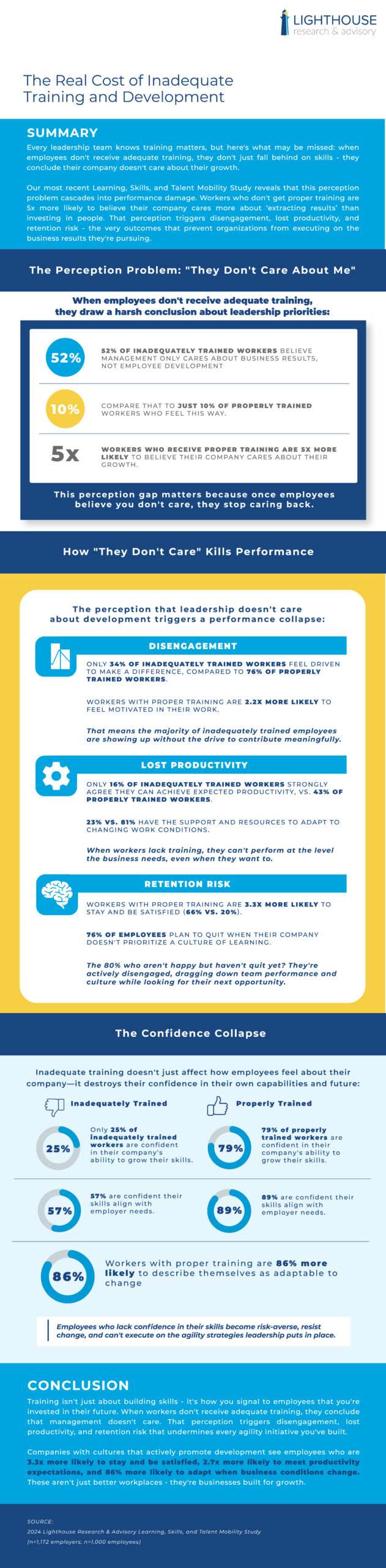
The 2024 Lighthouse Research & Advisory Learning, Skills, and Talent Mobility Study surveyed 1,172 employers and 1,000 employees, and revealed that workers who receive proper training are 5x more likely to believe their company cares about their growth.
This perception matters because once employees believe you don’t care, they stop caring back.
How It Kills Performance
The perception that leadership doesn’t care triggers a performance collapse:
- Disengagement becomes the norm.
Only 34% of inadequately trained workers feel driven to make a difference, compared to 76% of properly trained workers. The majority are showing up without the drive to contribute meaningfully. - Productivity suffers even when workers want to perform.
Just 16% of inadequately trained workers can achieve expected productivity, versus 43% of properly trained workers. When workers lack training, they can’t perform at the level the business needs. - Employees either check out or walk out.
Workers with proper training are 3.3x more likely to stay and be satisfied. The 80% who aren’t happy but haven’t quit yet? They’re actively disengaged, dragging down team performance while looking for their next opportunity.
The Confidence Collapse
Inadequate training doesn’t just affect how employees feel about their company – it destroys their confidence in their own capabilities and future. Only 25% of inadequately trained workers are confident in their company’s ability to grow their skills, versus 79% of properly trained workers. Workers with proper training are 86% more likely to describe themselves as adaptable to change.
Employees who lack confidence become risk-averse, resist change, and can’t execute on the agility strategies leadership puts in place.
What This Means
Training isn’t just about building skills. It’s how you signal to employees that you’re invested in their future. Companies that create cultures promoting development see employees who are 3.3x more likely to stay and be satisfied, 2.7x more likely to meet productivity expectations, and 86% more likely to adapt when business conditions change.
These aren’t just better workplaces. They’re businesses built for growth.

Roberta Gogos is an HR Industry Go-to-market Leader and Analyst. She has been behind the scenes at market-leading companies to help them shift market narrative, influence buyer behavior and expand into new markets. She is known for her ability to turn strategic vision into measurable execution through positioning, storytelling, and operational rigor.
Since 2024, Roberta has been focused on industry research used by investors, corporate leaders, and vendors to assess technologies and inform M&A decisions, improve GTM, enable sales, inform product development, and develop thought leadership.
She has 20 years of experience in marketing, positioning, and strategy, with 10+ years of that being directly related to talent and the workforce.
