
Companies don’t serve customers, solve problems, or innovate. People do. So when we talk about whether organizations are ready for disruption, we’re really asking: are your people ready? And based on what 700 employees told us in our November 2025 Learner Insights Survey, the honest answer for most companies is no.
Workers Already Get It
Your employees aren’t oblivious. They read the same headlines you do. They’re watching AI reshape industries. They’re clocking the layoffs, the restructures, and the “we’re pivoting our strategy” memos.
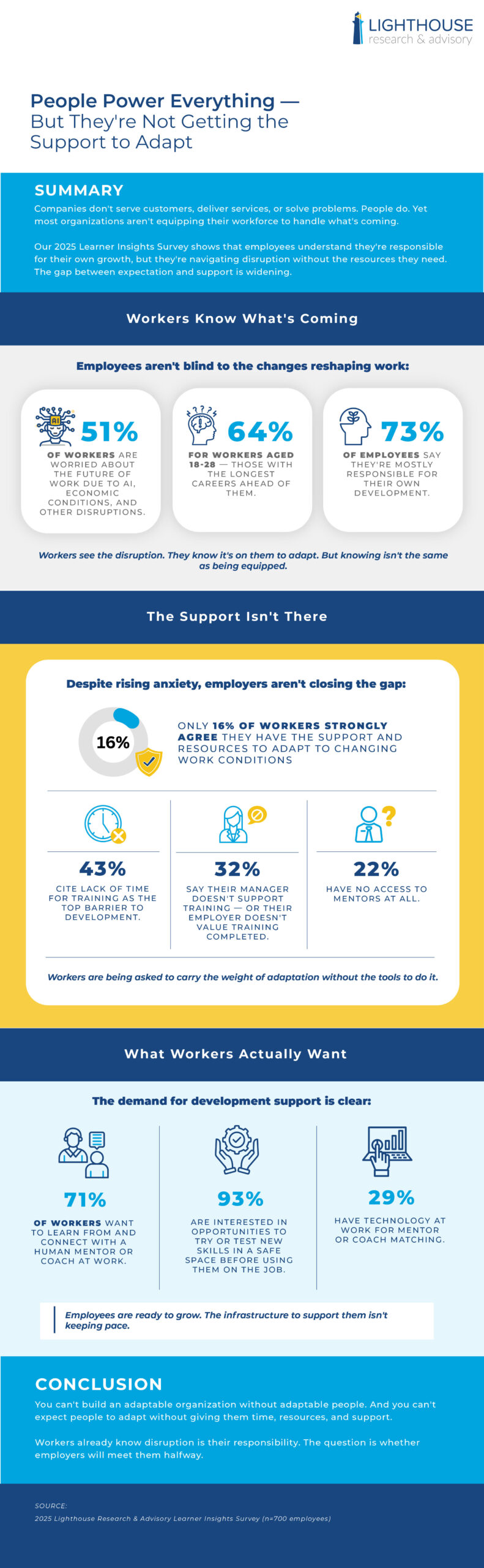
More than half of workers say they’re worried about the future of work. Among younger workers (18-28), it’s 64% — and these are the folks with 30 or 40 years of career still ahead of them. They’re doing the math on how many times the rules might change before they retire.
They’re also not sitting around waiting to be saved. 73% say they’re mostly responsible for their own development. They’ve accepted that. What they haven’t accepted is being left without the tools to actually do something about it.
The Gap Between Expectation and Reality
We asked employees if they have the support and resources to adapt to changing work conditions. Only 16% strongly agreed. That’s a big gap between “I own my growth” and “I have what I need to grow.”
The barriers are predictable:
- No time. 43% say lack of time is their biggest obstacle. Learning gets pushed to “later,” and later never comes.
- No backup from leadership. 32% say their manager doesn’t support training — or that the company doesn’t value the training they complete.
- No one to learn from. 22% have zero access to mentors. They’re figuring it out alone.
Workers are being asked to carry the weight of adaptation without the tools to do it.
This Shows Up in How People Feel About Staying
When employees feel unsupported, it doesn’t just affect their skills. It affects their commitment. And we’re seeing that play out in this year’s data.
More employees than last year say they’re uncertain about their future with their employer. But fewer are actively planning to quit. That’s not loyalty. That’s caution. People are holding onto jobs because the market feels shaky, not because they’re bought in.
We think of these folks as swing voters. Right now, they’re staying out of necessity. But the moment things shift — a better opportunity, a stronger job market, one more frustrating day — they’re out the door.
So what tips someone from “uncertain” to “I want to be here” you might ask?
Feeling like the company is investing in their future. When employees believe you’re helping them grow, they stop scanning job boards. Learning isn’t just about skill-building. It’s a buffer against all that anxiety about disruption. It tells people: we see you, we’re betting on you, you have a future here.
What Actually Helps
When we asked employees what they wanted, the answers weren’t complicated.
They want a human connection. 71% want access to a mentor or coach: someone who’s actually been where they’re trying to go. This holds across all age groups, and tells us AI can’t replace someone who knows your context.
They want to practice before it counts. 93% are interested in testing new skills in a safe environment before using them on the job. No surprise there.
Most companies aren’t delivering. Only 29% of employees have access to technology that helps match them with a mentor or coach. The demand is there. The infrastructure isn’t.
Managers Are the Linchpin
Managers sit at the center of development. They’re the ones making time for it or crowding it out, connecting people to opportunities or leaving them to figure it out alone.
When we looked at data on employee belonging (whether people feel accepted, respected, and appreciated) we found that employees with high belonging are twice as confident their employer understands their skills and abilities. That confidence comes from managers who actually talk to people about where they’re headed and how to get there.
Without that, employees are left guessing whether anyone sees their potential at all.
So What Now?
Workers have already accepted that their development is their responsibility. 73% have made peace with that. The question is whether you’ll meet them halfway.
- Give them dedicated time built into the workload.
- Give them people. Mentors, coaches, and managers who make time to discuss skills, growth, and next roles.
- Give them a reason to believe you’re invested. Because right now, most of them don’t.
Development isn’t just about skills. It’s the buffer your people need to face disruption without panicking. Give them that, and they’ll carry the business through whatever comes next.

Roberta Gogos is an HR Industry Go-to-market Leader and Analyst. She has been behind the scenes at market-leading companies to help them shift market narrative, influence buyer behavior and expand into new markets. She is known for her ability to turn strategic vision into measurable execution through positioning, storytelling, and operational rigor.
Since 2024, Roberta has been focused on industry research used by investors, corporate leaders, and vendors to assess technologies and inform M&A decisions, improve GTM, enable sales, inform product development, and develop thought leadership.
She has 20 years of experience in marketing, positioning, and strategy, with 10+ years of that being directly related to talent and the workforce.
