
I once watched a leader walk into a team meeting after a particularly difficult quarter. The numbers were not where they needed to be, the team was tired, and frustration had begun to affect the way people were working together. Everyone in the room expected the conversation to begin with the missed goals, the performance gaps, and what needed to change. Instead, the leader started with the people.
He looked around the room and said, “Before we talk about what we need to fix, I want to acknowledge what you have carried to get us here. I know it has not been easy. I see the effort, and I appreciate what you have continued to give. Now, let’s talk about what we can do together.”
The conversation that followed was noticeably different. People were more willing to speak openly about what was getting in the way, ideas began to surface, and accountability actually increased because the team no longer felt as though the numbers were being used to judge their worth. The leader did not lower the expectations or ignore the performance problem. He simply understood that people are more willing to confront difficult challenges when they believe their leader sees them, values their contribution, and will support them through the work. That is the leadership impact on culture.
Culture is how most employees feel, believe, and behave, most of the time.
We often talk about culture as though it belongs to HR, and while HR plays an incredibly important role in shaping the systems, programs, and experiences that influence culture, leadership ultimately determines whether those things become part of the everyday employee experience. You can have a thoughtful recognition strategy, an impressive engagement initiative, and all the right language about values, but if employees experience something completely different from their leaders, the program will never become the culture. Culture is created in the moments between leaders and employees, particularly when the work becomes difficult, expectations are high, mistakes happen, or people are asked to give more than they expected.
That is why our latest research with ITA Group is so important. It looks at the relationship between culture and three leadership behaviors that can significantly shape the employee experience: Appreciation, Recognition, and Trust. Together, they form what we (ITA Group) call the A.R.T. Approach.SM, a practical way to think about how leaders create the conditions for people to perform and thrive.
Appreciation: Do you see me?
Appreciation begins with something remarkably simple but often overlooked: making people feel seen as human beings, not simply as employees responsible for delivering a result.
A leader who notices the extra effort someone is making, acknowledges the pressure they are carrying, or takes a moment to express genuine gratitude sends a message that the person matters beyond the immediate task. Appreciation does not always require a formal program, a reward, or public recognition. Sometimes, it is simply a leader paying enough attention to recognize that someone’s contribution deserves to be acknowledged. That matters because people want to know that their work and their presence have meaning.
Recognition: Do you see what I have done?
Recognition takes appreciation a step further by making someone’s contribution visible and connecting it to something that matters. Instead of simply saying, “Great job,” effective recognition helps employees understand what they did well, why it mattered, and how their behavior contributed to the team, customer, or organization.
That distinction is important because meaningful recognition reinforces the behaviors leaders want to see repeated while helping employees understand how their individual contributions connect to organizational performance. When recognition becomes specific, timely, and authentic, it stops feeling like a transaction and starts becoming part of the culture.
Trust: Will you support me?
Trust is where appreciation and recognition become more powerful because it gives employees the confidence to bring their best to the work.
Employees need to believe that their leader will listen to them, give them room to contribute, provide support when challenges arise, and allow them to learn without making every mistake feel like a threat to their future. Trust does not mean lowering standards or avoiding accountability. In fact, healthy trust makes accountability stronger because people are more willing to be honest about what is happening when they do not fear what will happen when they speak. Without trust, appreciation can feel performative, and recognition can feel transactional. With trust, both become part of a genuine leadership relationship.
Leadership Creates the Conditions
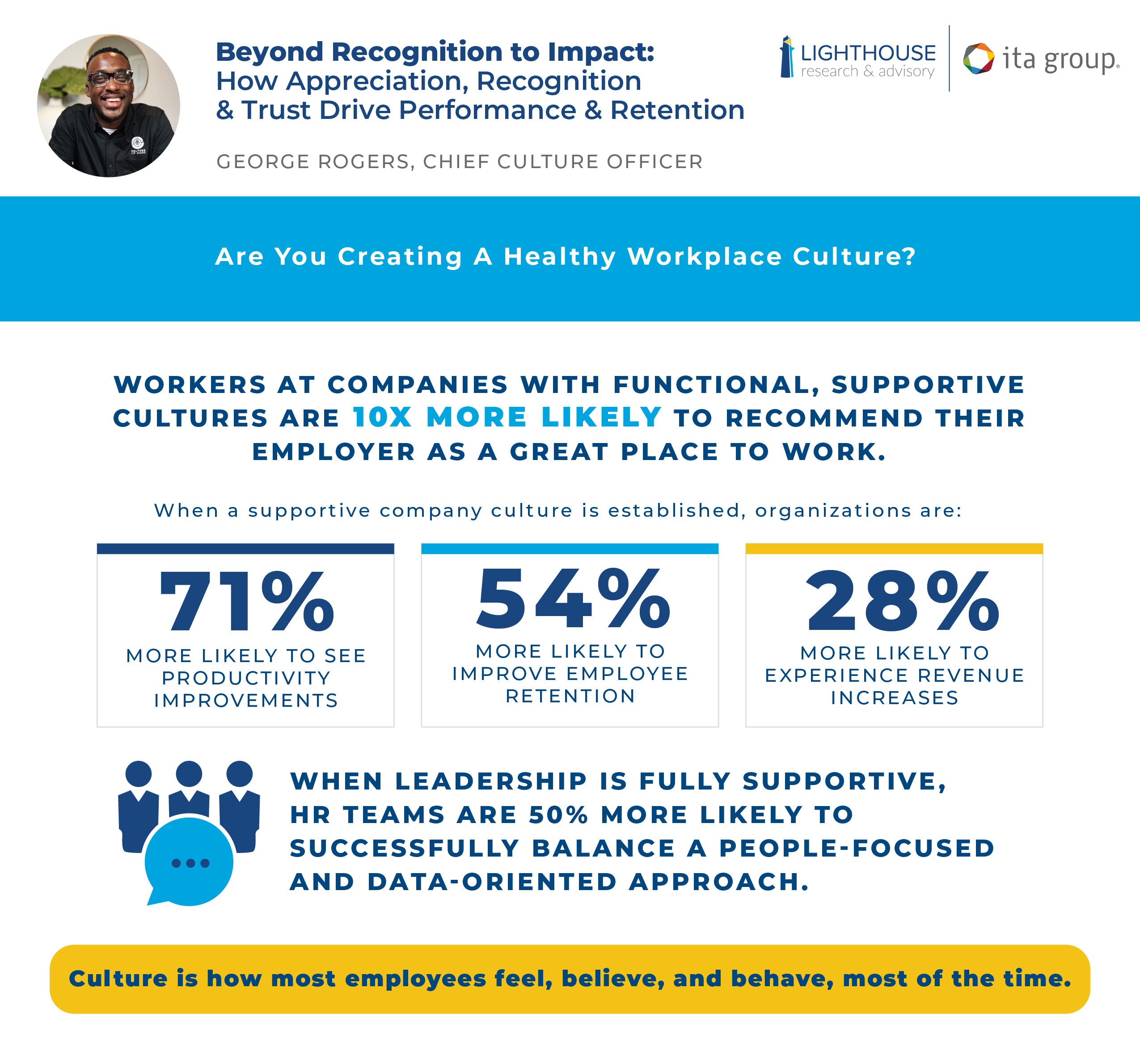
One of the most important conversations happening in organizations today is the tension between being people-focused and being data-driven. Too often, those ideas are presented as competing priorities when the strongest organizations understand that they need both. When leadership is fully supportive, HR teams are 50% more likely to successfully balance a people-focused and data-oriented approach. (See graphic below)
Click and download the full infographic here
That statistic is bigger than HR. It speaks to the conditions leaders create for their organizations.
When leaders support HR as a strategic partner, the conversation can move beyond simply asking whether employees are happy or whether the business is hitting its numbers. Instead, leaders can begin asking more meaningful questions: What are our people experiencing? What is influencing their performance? Where are we creating friction? What behaviors are strengthening the culture, and which ones are quietly working against it? That is where people data and business data become more powerful together.
Healthy cultures are not created by choosing people or performance. They are created when leaders understand that sustainable performance depends on creating an environment where people have the support, clarity, recognition, and trust necessary to perform at their best. Our research reinforces that connection, showing that supportive cultures are associated with stronger productivity, retention, and business outcomes.
So perhaps the question leaders should be asking is not simply, “How do we improve our culture?” A better question may be, “What are people consistently experiencing from us?” Do they feel seen when the work gets difficult? Do they understand that their contributions matter? Do they believe their leaders will support them when they speak up, take a risk, or make a mistake? Because those experiences become beliefs, those beliefs influence behavior, and those behaviors ultimately become culture.
The healthiest leadership cultures understand that appreciation, recognition, and trust are not soft ideas sitting on the sidelines of business performance. They are leadership behaviors that create the conditions for people to contribute, perform, stay, and grow. That is the power of the A.R.T. Approach.SM.
Appreciation makes people feel seen. Recognition makes their contributions visible. Trust gives them the confidence to bring their best.
When leaders consistently practice all three, culture stops being something written on a wall or discussed in an engagement survey and becomes something employees can actually experience every day. And when people experience a culture where they feel seen, valued, supported, and trusted, they are not simply showing up to do a job. They have a greater opportunity to thrive.
Read the full Beyond Recognition To Impact report

George Rogers is the Chief Strategy Officer at Lighthouse Research & Advisory. He is an author, coach, and globally renowned keynote speaker acclaimed for delivering compelling insights on cultivating purpose-driven, profitable businesses. As a leader developing inclusive and motivating workplace environments, he consistently provides transformative perspectives and guidance to organizations worldwide. Over the past two decades, he has dedicated himself to inspiring leaders and transforming workplace cultures.
In his book Champion Your Purpose, we learn that finding purpose in life looks different for everyone, and very few will find the exact common purpose that aligns the exact same. He provides a step-by-step approach to help readers identify their purpose and align it with their personal and professional goals.
His research focuses on leadership and its impact on performance, engagement, culture, mental health, inclusion, and belonging. If you ask him what led him to the HR space, he will remind you that his passion and purpose are championing people.
With over 25 years of leadership and keynote speaking experience, he has inspired, empowered, and challenged every audience —virtually and in person —to discover their purpose in the workforce, learn how to Champion Your Purpose individually, and lead the life they love.
