
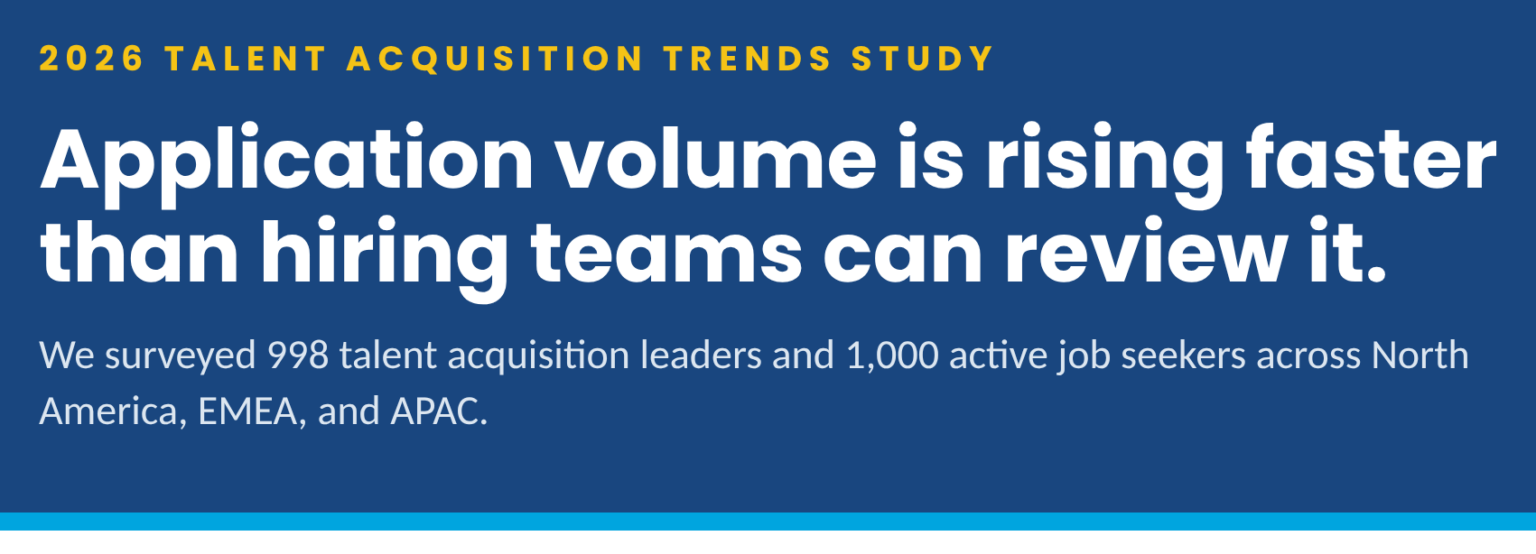
Over the past two years, in our own hiring and in our work with client organizations, we’ve watched the same pattern play out again and again. Job postings pull in more applicants than ever, but a smaller share of them deserve a closer look. Earlier in 2026, we surveyed 998 talent acquisition leaders and 1,000 active job seekers across North America, EMEA, and APAC to find out what’s driving it.
Since then we’ve had:
- A virtual research release event with over 1,000 companies signed up to hear the study outcomes
- A special look at the RPO specific findings from this study
- A deep dive into the reasons companies struggle to bring AI into hiring practices
- Plus over a dozen speaking events this year highlighting various takeaways and trends from the study.
Want to jump right in? Download the report now.
Note: we’re in the process of pulling together themes for our 2027 TA study that launches in Q1. If you’re an employer with ideas on what we should cover, reach out and let us know what’s on your mind! If you’re a technology or service provider in the industry, let us know what you are hearing from your clients or if you’d be interested in partnering on the research.
Want a preview? Here’s what we found.
Teams can’t keep up with application volume.
72% of employers report higher application volume over the past year, but fewer than six in ten (59%) can thoroughly review most of the resumes they get. 11% told us that reviewing resumes feels like a game of chance. One advisory client told us they are getting hundreds of applicants for every opening but fewer than 1% of them are the high-quality hires they have made in the past. A game of chance indeed!
AI saves recruiters time but creates new work.
71% of recruiting teams use AI, and 76% of those teams save two or more hours a week per recruiter. Nearly half also say it has increased the need for oversight. The role of recruitment is changing, and that’s one of the big themes we’re planning to explore in our 2027 edition of this research.
Teams are cutting the steps that could actually build (or rebuild) trust.
Employers most want to put time freed by automation toward candidate experience (57%). Over the past year, though, 80% of teams cut at least one activity because they lacked capacity, most often candidate feedback loops (34%). AI is supposed to make hiring more human, but that may not be playing out as expected.
Employers say they trust resumes but rely on them less in final decisions.
76% think resumes reflect candidate skills, yet 64% have hired someone whose performance didn’t match their resume, and 98% already trust several other signals more than the resume (things like a job simulation, assessment, and other signals, as the report shows).
Employers and candidates don’t trust each other.
Three in four employers (74%) believe candidates misrepresent themselves at least occasionally, and only 15% of candidates call employer branding very honest. Both groups name lack of feedback as the top reason candidates lose trust (50% of employers and 61% of candidates).
Candidates want a human making the final hiring decision.
Just 13% are comfortable with AI choosing who gets hired. If AI is used to evaluate them, 45% want the option to request a human review.
These findings point TA leaders to three priorities:
- Decide how recruiters will spend the time AI saves them, and make someone responsible for candidate communication.
- Agree on how to evaluate skills assessments, structured interviews, and work samples so teams depend less on resumes.
- Audit any AI that ranks or screens candidates, including tools that only produce a shortlist.
Employers and candidates both want faster hiring, and neither is getting better outcomes from it. AI is saving recruiters time, but those hours don’t always go where employers plan.
One leader of a professional recruitment organization told us his biggest battle with AI time savings was keeping those hours from going to Netflix, TikTok, and other time wasters. Employers say they want to spend saved time on candidate experience (we think that would be time well spent!). That only happens when someone owns candidate communication, sets a standard, and tracks it.
In the full report, you’ll find what’s competing for recruiters’ time, why resumes carry less weight in final decisions, and what candidates chose when we showed them real job postings, AI disclosures, and rejection notices.
Download the report and check out these and other findings → 2026 Talent Acquisition Trends Report
Thanks to Criteria Corp, Phenom, and the RPO Association for partnering with us on this research in 2026!

Ben Eubanks is the Chief Research Officer at Lighthouse Research & Advisory. He is an author, speaker, and researcher with a passion for telling stories and making complex topics easy to understand.
His latest book Artificial Intelligence for HR (3rd Ed) showcases how employers can balance AI adoption with a people-first approach. It is the world’s most-cited research on AI applications for HR.
His other books include Talent Scarcity, which answers the question every business leader has asked in recent years: “Where have the high-quality workers gone, and how do we hire and keep them?” It shares practical and strategic recruiting and retention ideas and case studies for every employer.
Ben has more than 15 years of experience both as an HR/recruiting executive as well as a researcher on workplace topics. His work is practical, relevant, and valued by practitioners from F100 firms to SMB organizations across the globe.
He has spoken to tens of thousands of HR professionals across the globe and enjoys sharing about technology, talent practices, and more. His speaking credits include the SHRM Annual Conference, Seminarium International, PeopleMatters Dubai and India, and over 100 other notable events.
