
The results are in.
After multiple real-world experiments, we’ve seen that the future of work is a human one. Companies are going all-in on AI and are losing millions of dollars because they do it the wrong way. Here are some real examples from Ford, Klarna, and IBM.
Overview of AI Layoff Reversals
| Company | Workers Replaced | The Problem / Result | The Outcome |
|---|---|---|---|
| Klarna | ~700 customer service agents | Pushed too aggressively for cost savings over quality. AI handled routine questions but completely failed on complex edge cases, multi-step problem solving, and emotionally charged issues, sending customer satisfaction plunging. | Quietly rehired human staff. The CEO publicly admitted: “Cost was a too predominant factor. What you end up with is lower quality.” |
| Ford | Undisclosed (replaced engineering quality checks with 900 AI cameras) | Intended to catch physical defects using AI models. However, the automated cameras lacked the nuanced tribal knowledge and context of human experts, letting critical manufacturing defects slip through. | Hired back 350 veteran engineers (referred to internally as the “gray beards”) to fix the automated system, lead physical reviews, and mentor younger staff. |
| IBM | 7,800 back-office roles paused; “a couple hundred” HR staff cut |
Deployed an automated system to manage HR requests. While the AI managed roughly 94% of highly routine queries, it stumbled severely on the remaining 6% which involved complex, nuanced, or ethical employee issues. | Realized that bypassing junior roles was completely drying up their talent pipeline for future leadership. Shifted to a hybrid model and announced plans to triple U.S. entry-level hiring. |
Let’s take this a step further. If Ford had to rehire 350 veteran engineers over the last few years, re-recruiting highly specialized automotive engineers, engineering contractors, or specialists from suppliers means paying a massive premium. At an estimated loaded compensation of $150,000–$200,000 per engineer, the payroll alone to bring them back costs $52M – $70M annually. But that’s not the most painful part, because the quality issues could cost tens of millions more to correct once the engineers were back on staff and able to review the problems.
How You AI Matters
Is AI going to change jobs? Certainly. In many companies it already has. But as with any successful (or unsuccessful) organizational change, how things get done matters greatly.
One of my favorite ways to put this:
- Companies don’t respond to change.
- Companies don’t develop products.
- Companies don’t serve customers.
Companies don’t do any of these things. People do. Employees do. That’s where the real value comes from. Even in a world where “agentic” is being added to every phrase regardless of whether it’s honest (agentic hiring), whether it makes sense (agentic benefits), or whether it is even necessary (agentic sandwiches?), people are the core of every successful business.
We see in our research over and over that AI is a powerful tool and resource, but it’s not a replacement for true human capability. Human judgment and discernment is a differentiator that makes your best staff stand out from the competition. In a world where anyone can use AI to do nearly anything, the people are the secret sauce that sets one organization apart from another.
In our research we’re going to be exploring this idea of a Human Future of Work more fully in the coming year. We tested it out this summer at our flagship HR Summer School event in June. We had over 12,000 comments from the audience during this event which was themed “The Future of Work is Human.” I think we struck a nerve.
AI in HR and AI for HR
This conversation is especially pertinent to the role of human resources. The People profession is about people. It’s not about how we squeeze the most from them like we’d squeeze every last drop from a lemon. When done well, HR is about aligning the best our people bring to the table with what the organization needs from them. That is what I personally learned when training to become an HR professional. That’s what I tested on when I got certified. That’s what I carried out daily in leadership meetings, manager coaching, and interactions with frontline staff.
We see in preliminary data on this topic that just 2% of employers believe that AI is equally effective as human-led HR at managing the needs of humans at work. 2%. The other 98% say that there are a range of benefits of having humans supporting the needs of the workforce, including a feeling of support and appreciation/value, personalized help, and higher trust.
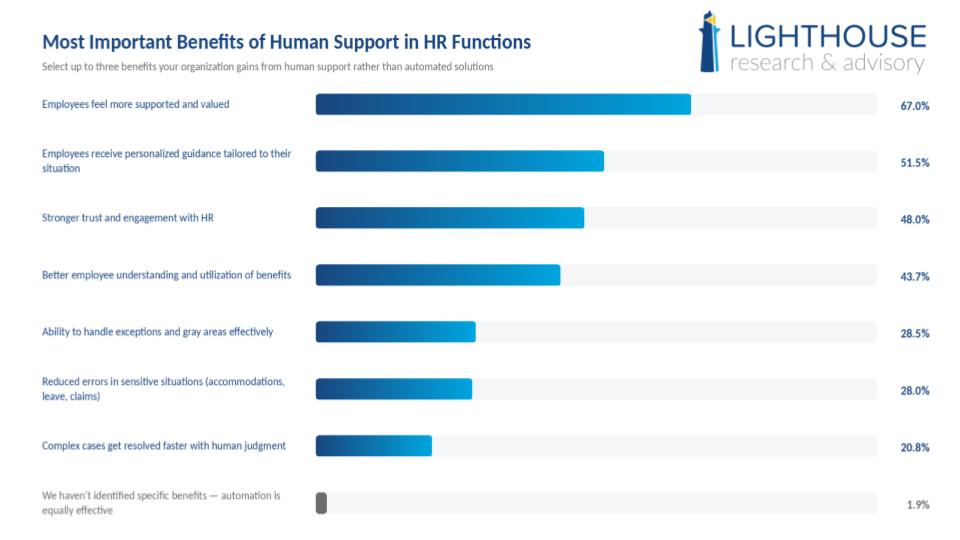
Interesting, then that when we look at the new research coming out from HBR about AI being included on organizational charts, we see a very negative response:
A recent study involving over 1,200 professionals demonstrates that framing AI as a colleague rather than a tool leads to a decline in error detection and personal accountability. Specifically, managers caught 18% fewer errors and experienced a 9 percentage point drop in personal accountability when reviewing work attributed to an AI employee. Source: HBR
When we add AI to the mix, especially in the pursuit of “just use AI,” like is the case in so many organizations, we end up in a place that none of us would willingly choose to go. Who among us would prefer a drop in personal accountability, increased errors, and a rise in the number of tasks escalated up the organizational hierarchy because of mistrust in AI decisions?
Take Caution: AI Can Seem “Easy” When It’s Not
In the interest of stepping off the soapbox and talking directly to the thousands of employers we reach with our research, please hear this: AI is a fantastic tool for many uses, but it’s an absolutely awful one for others. I’m all for companies exploring and experimenting, but couldn’t we have determined that AI cameras were not effective in a small pilot at Ford instead of reducing our engineering headcount and having to rehire 350 people? Couldn’t Klarna have determined that AI was less capable than humans with a test of one department or business unit instead of getting rid of all of their capable service team?
The future of work is a human one, both within HR and within the broader organization. While delivering a workshop on AI best practices and use cases for a manufacturer’s global HR team earlier this summer, I explained the lesson that all of us learn in first grade: there’s no free lunch. When you get into higher levels of education you learn the term for this: opportunity cost. Nothing has all upside and no downside. Even though AI seems very capable, it’s like that employee many of us have worked with that explored every possible lie and excuse for not getting to work on time. That person put extra effort into making us believe them. AI does the same. It tries to mimic believability. It tries to copy confidence. But it’s really just a probability generator in the end.
Humans mess up. Sometimes we do it spectacularly. But we also succeed in ways that would be unbelievable if there weren’t records to prove those successes. There have been many publications recently highlighting AI’s capabilities at math, sometimes solving equations that have been unsolvable for decades.
If only life was as straightforward as math: a right answer, a wrong answer, and a clearly laid out set of steps to determine one from the other. In reality life is much more messy. We make decisions without having all the variables. We have to adapt and adjust course midstream. And we do it all in the absence of a fast, repeatable feedback loop to keep us on course.
What We’re Doing About It
First, I’m on the road on a regular basis doing training and workshops for employers that want something different. Too much AI training, especially for HR, is either generic to the point of being useless or technical to the point of creating headaches for the audience. There’s a middle ground. We have worked with dozens of employers this year to help their teams find low-risk, high-value use cases for AI adoption within their HR teams. Success her has to start with your purpose, not your AI system of record.
Second, you’re a company that believes the future of work is human, let’s talk. It’s a message that needs to be heard loud and clear. We are talking with organizations that develop technology for benefits, training, hiring, engagement, HR service delivery, and more to go deep into this topic of human work. It’s not about acting like AI doesn’t matter. It’s about using the best that your people bring and combining that with the best that AI brings for optimal results.
Third, this research is coming. We’re going to go deep to understand where AI should and shouldn’t be used, what helps create a more human work environment even in the midst of AI adoption, and how to ensure that people aren’t left behind in the AI era.

Ben Eubanks is the Chief Research Officer at Lighthouse Research & Advisory. He is an author, speaker, and researcher with a passion for telling stories and making complex topics easy to understand.
His latest book Talent Scarcity answers the question every business leader has asked in recent years: “Where are all the people, and how do we get them back to work?” It shares practical and strategic recruiting and retention ideas and case studies for every employer.
His first book, Artificial Intelligence for HR, is the world’s most-cited resource on AI applications for hiring, development, and employee experience.
Ben has more than 10 years of experience both as an HR/recruiting executive as well as a researcher on workplace topics. His work is practical, relevant, and valued by practitioners from F100 firms to SMB organizations across the globe.
He has spoken to tens of thousands of HR professionals across the globe and enjoys sharing about technology, talent practices, and more. His speaking credits include the SHRM Annual Conference, Seminarium International, PeopleMatters Dubai and India, and over 100 other notable events.
