
AI can automate calculations, analyze pay gaps, and even predict who might quit. What it cannot do is sit across from a manager and explain the story behind a pay decision. It cannot balance empathy and equity. It cannot connect data to business context the way a seasoned compensation leader can.
Most of the conversation about AI in compensation right now is about which tasks should get automated. That matters, and our research covers it in depth, but it skips past a potentially more interesting question. When these tools do free up time, what do compensation professionals do with it?
We asked that question directly in our most recent compensation study, and the answers say a great deal about what this function believes its real work is.
Fact: Compensation teams manage far more than they used to
In our latest Compensation Technology and Data Trends Study of 762 employers, 59% told us that compensation has become more difficult and challenging over the last 12 to 18 months.
What is making it harder will sound familiar to anyone doing this work.
- Forty-two percent are balancing employee expectations against limited compensation budgets
- 41% are trying to keep pace with market pay rates and inflation that will not sit still.
- Another 35% are managing wage compression between new hires and the people who have been there for years,
- One third of employers are implementing new technology on top of everything else.
Every one of those challenges is additional work rather than a replacement for something else. The demands on compensation professionals keep piling up, so asking what they would do with an extra hour is something of a trick question.
Where employers are pointing AI
If an extra hour came from anywhere, employers expect it to come from automation. We asked which compensation activities they expect to become more automated over the next two to three years, and the list ran long. Pay equity analysis topped it at 57%, followed by compensation modeling and budgeting at 46%, job matching at 41%, market pricing at 38%, survey participation at 35%, and report generation at 34%.
This is building on a foundation that’s already pretty rich. Forty-four percent of employers are already using AI or machine learning somewhere in their compensation work today, and another 34% are actively exploring it.
Based on responses, employers are aiming these tools mostly at the mechanical portion of compensation work, which is what the technology handles well. That leaves the conversations and the judgment calls where they have always been with the compensation professional. But even on the mechanical work, the tools are falling short of what buyers expected. AI features rank among the capabilities buyers value most in their compensation software, and they also rank first on the list of features buyers are most dissatisfied with.
What teams say they would do with freed up time
With time being the constraint in this function, we wanted to know what compensation professionals would do with a bit more of it. We asked HR and compensation professionals: if you had one extra hour of time available in your work schedule, where would you invest or spend it first? Each of the 762 respondents picked one answer from a list of ten.
How Compensation Practitioners Would Spend an Additional Hour
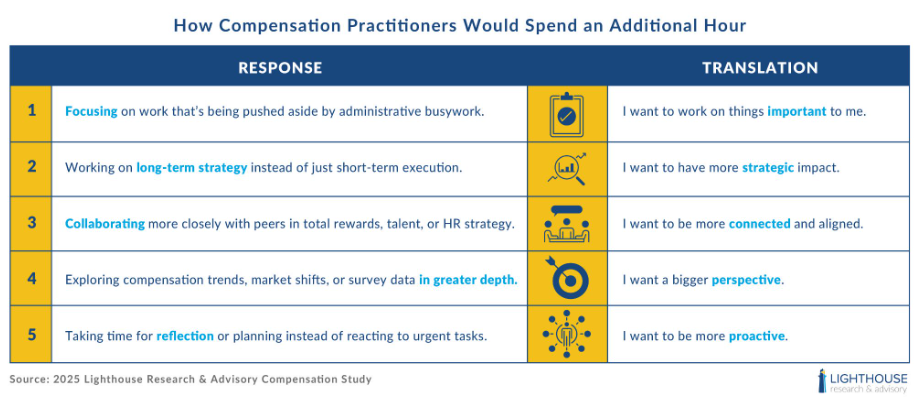
The most common response, chosen by 17%, was to spend the hour on work that administrative busywork keeps pushing aside. Another 15% said they would work on long-term strategy instead of short-term execution. Twelve percent would collaborate more closely with peers in total rewards, talent, or HR strategy. Eleven percent would explore compensation trends, market shifts, or survey data in greater depth, and another 11% would take time for reflection or planning instead of reacting to urgent tasks.
What responses have in common
The top five responses listed above describe strategic or planning work that requires a person: understanding why market pay rates have moved takes knowledge of what is happening inside the business; working more closely with peers in total rewards and talent depends on relationships; making time to reflect and plan calls for someone willing to look beyond the current cycle. These are the exact same capabilities we identified in the report as the ones AI cannot replicate.
The five options that ranked lowest are worth a look as well. Revisiting compensation policies or programs that need attention drew 8%. Coaching managers to improve pay conversations and building new dashboards or reports each drew 6%, and deepening relationships with business leaders and executive stakeholders drew 5%.
From a workload and work satisfaction perspective, only 6% would use an extra hour to catch their breath and regain a sense of control over their schedule, which placed ninth out of ten.
That tracks with how they see the function evolving. When we asked what compensation will look like in two to three years, 60% said more integrated with other HR and reward functions, 55% said more focused on data analytics, and 47% said more involved in business strategy. In other words, given one free hour today, compensation professionals would spend it on the tasks that build towards their vision of work two to three years from now.
The skills data points in the same direction. Familiarity with AI and machine learning is the fastest-rising skill on our list for the years ahead. At the same time, data analysis, technical compensation knowledge, and communication and influencing all stay near the top. Compensation professionals are not expecting these tools to take over the judgment work and leave them to operate software. They expect to need both sets of skills, which is why the extra hour goes toward the human side of the job.
A word of caution
There is a lot to be excited about here, and a fair amount to watch carefully. Demand for skilled compensation leaders has rarely been higher. At the same time, we are layering AI onto a function whose decisions affect people’s livelihoods directly, and that is reason enough to be deliberate about where these tools get used and where they do not.
Consider one trend we are already seeing. Some companies are using algorithms to set pay at the individual level, tuned just high enough to prevent turnover but not so high that they waste money on anyone. It is efficient. It also risks reducing people to numbers.
The same technology that gives a compensation team room to think can be used to take the thinking out of the process entirely. Which of those you end up with has less to do with the tools than with what your team decides to do with the capacity they create.
What compensation teams are really asking for
Compensation has always been about data. It has also always been about judgment, communication, and trust. Our research keeps arriving at the same conclusion: as AI takes on more of the analysis, the human part of this job matters more.
A lot of this work happens without much recognition from the rest of the business. But when we offered 762 HR and compensation professionals one hypothetical hour, they chose strategy, perspective, connection, and time to think.
That should tell you what to do when automation does free up the time. Decide in advance where it goes, and tell your leadership what you plan to do with it.
Read the full Compensation Technology and Data Trends report

Roberta Gogos is an HR Industry Go-to-market Leader and Analyst. She has been behind the scenes at market-leading companies to help them shift market narrative, influence buyer behavior and expand into new markets. She is known for her ability to turn strategic vision into measurable execution through positioning, storytelling, and operational rigor.
Since 2024, Roberta has been focused on industry research used by investors, corporate leaders, and vendors to assess technologies and inform M&A decisions, improve GTM, enable sales, inform product development, and develop thought leadership.
She has 20 years of experience in marketing, positioning, and strategy, with 10+ years of that being directly related to talent and the workforce.
